
Complex Restorative Dentistry · Coral Springs, FL
When a lot is going wrong in your mouth, the plan matters more than the procedures.
Failing crowns. Worn teeth. Old fillings breaking down. A missing tooth or two, and a bite that doesn't feel the way it used to. When problems accumulate, fixing them one at a time stops working — because the problems are usually connected. The first step isn't more dentistry. It's understanding why the mouth got here.
Start with a comprehensive evaluation Call or text 754-240-4820
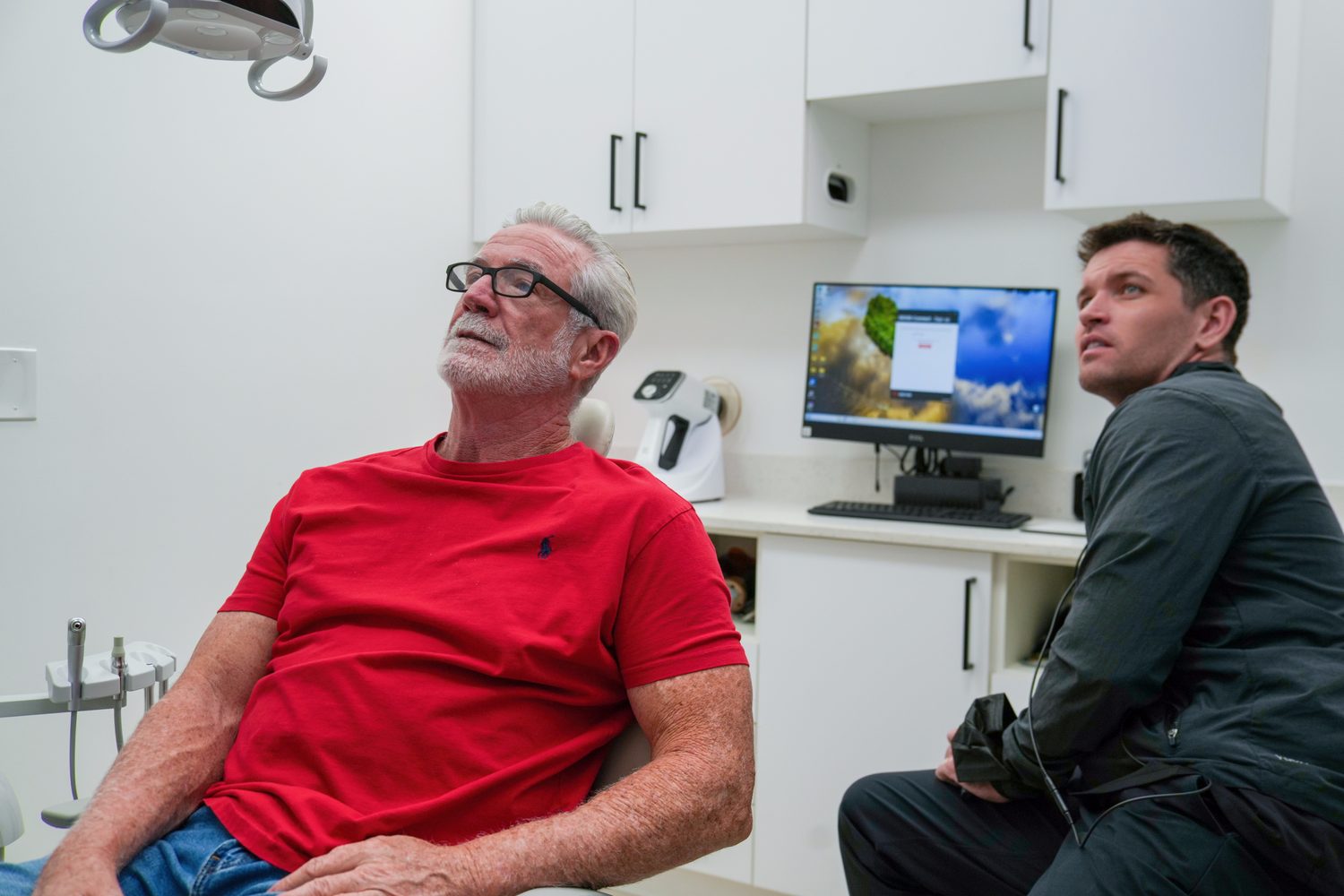
What is complex restorative dentistry? It is the diagnosis and coordinated treatment of a mouth where several problems interact — failing restorations, worn or fractured teeth, missing teeth, bite instability, gum disease. Rather than repairing teeth one at a time, the dentist first determines why the mouth reached its current condition, then sequences treatment so the repairs last.
Complex dentistry is not one procedure
Dental care is usually organized by procedure: a crown here, an implant there, gum treatment somewhere else. That works when you have one problem. It stops working when you have several, because the real question is no longer "what does this tooth need?" It's "what is happening in this mouth, and in what order should it be addressed?"
The patients we see for complex care usually arrive with some combination of the following:
- Crowns or bridges that are failing or have failed before
- Large, aging fillings doing more work than a filling should
- Cracked or fractured teeth
- Missing teeth, replaced or not
- Existing implants that need to be worked around
- Root canal-treated teeth with uncertain prognosis
- Gum (periodontal) disease, active or treated
- A bite that has shifted, collapsed, or become unstable
- Teeth visibly worn down or getting shorter
- Recurrent decay around older dentistry
- Previous dental work reaching the end of its life all at once
- Esthetic concerns layered over all of the above
No two of these lists look alike, which is exactly the point. Complex care isn't a product you order. It's a diagnostic process that produces a plan specific to one mouth.
Why the mouth got here matters more than what to fix first
Here is the pattern we care most about interrupting: a tooth breaks, it gets repaired, and two years later a different tooth breaks — or the same one does. Each repair was reasonable on its own. But nobody asked why teeth in this mouth keep breaking.
Dentistry fails for reasons: a bite that overloads certain teeth, grinding the patient doesn't know about, acid softening enamel, gum disease undermining foundations, or old restorations that left too little natural tooth behind. If those causes are still active, new dentistry inherits the same conditions that destroyed the old dentistry — usually on an accelerated schedule, because each repair cycle removes more tooth structure.
Rebuilding a mouth without understanding why it broke down is how you end up rebuilding it twice.
This is why our evaluation spends as much time on causes as on damage. It's also why the answer to "what would you do about this tooth?" is sometimes "let me first understand what's happening to all of them." We've written more about this pattern in Why Dental Work Fails — and How to Make It Last and The Mouth Is a Hostile Environment.
The four questions we answer before recommending anything
1. Is disease still active?
Decay and gum disease are infections, and you don't build on top of an active infection. Periodontal measurements, decay risk, and the health of root canal-treated teeth get established first — because they determine which teeth are worth investing in at all. Where gum treatment is needed, it comes before restorative work, not after. Our guide to gum disease and when a specialist is needed covers this in more depth.
2. What is each tooth's honest prognosis?
Every tooth in a complex plan gets its own evaluation: how much sound structure remains, where the fractures are, what the roots and bone look like, how many times it has already been repaired. Some teeth are solid. Some are restorable with the right approach. Some look salvageable but carry a poor long-term prognosis — and putting an expensive restoration on a tooth that's likely to fail is a decision you should get to make knowingly, not discover later. The save-the-tooth-or-replace-it decision deserves its own discussion, and we've given it one.
3. Is the bite stable?
The bite is the force system every restoration lives inside. If teeth are worn flat, if back-tooth support has been lost, or if the jaw closes somewhere different from where the teeth want to meet, new crowns built to the current bite inherit the current problem. Sometimes the bite is fine and this step is quick. Sometimes it's the entire case. Our guides on bite collapse, tooth wear, and finding your true bite explain how we evaluate this.
4. What do you actually want?
Two patients with identical X-rays can have different right answers. One wants the most durable result available and is prepared to phase it over two years. Another wants the most conservative path that keeps them comfortable and out of trouble. Both are legitimate. A plan that ignores what the patient values isn't a plan — it's a quote. This is also where honest conversations about budget, time, and treatment burden belong: at the beginning, not after the work has started.
If you want to see how these four questions get scored systematically, our dental risk assessment guide walks through the framework we use.
Three honest outcomes of a complex evaluation
Patients sometimes assume that a comprehensive evaluation is the front door to an enormous treatment plan. Here is what actually comes out of ours:
Preserve and monitor
Some mouths that look complicated are actually stable. Old dentistry that is worn but sound can often stay. When that's what we find, the plan is maintenance, monitoring at defined intervals, and knowing in advance what would change the picture.
Targeted repairs
Often only part of the mouth needs work. A few strategic restorations — done with the bite and the underlying causes accounted for — can stabilize things for years. Not every complex mouth needs comprehensive reconstruction.
Staged reconstruction
When breakdown is extensive and progressing, rebuilding is the honest answer. Even then, treatment is usually phased: disease control first, then the foundation, then the restorations — one plan, executed in stages you can manage.
All three are real outcomes we deliver regularly. If every evaluation at a practice ends in the third column, that tells you something about the practice — a point we make at more length in our guide to advocating for yourself at the dentist.
The same judgment applies at the level of a single tooth. Our goal isn't to choose the smallest restoration or the largest one — it's to choose the appropriate one. Sometimes that means a filling. Sometimes an onlay. Sometimes a crown is the most predictable option for a tooth that has lost too much structure to protect any other way. The right restoration for the right tooth, decided on findings. Under-treating a structurally compromised tooth can cost it just as surely as over-treating a healthy one — conservative dentistry means preserving what is sound and protecting what is not.
How treatment is sequenced when reconstruction is warranted
When a mouth does need extensive work, the order is not negotiable, because each stage protects the investment made in the next:
- Stabilize disease. Gum health established, active decay controlled, teeth with hopeless prognosis addressed. Nothing durable gets built during this phase — and nothing durable should.
- Verify the foundation. The bite is evaluated and, where necessary, tested — sometimes with a splint or provisional restorations — before final work is made. If vertical dimension needs to change, this is where we prove the new position is comfortable. See how deprogramming works.
- Restore deliberately. Final crowns, onlays, implants, or combinations — designed digitally, sequenced so early work doesn't have to be redone to accommodate later work. Where implants are involved, planning starts from the final tooth position, not the available bone: how implants are really planned.
Phasing is normal. Many of our reconstruction patients spread treatment over one to three years, in an order designed so the mouth is stable and comfortable at every intermediate point. What makes phasing safe is that all the phases belong to one plan — for more on when a full rebuild is and isn't warranted, see our full-mouth reconstruction page.
Who does this work at MSD
MSD Dental Studio is on N University Drive in Coral Springs. Complex restorative cases here are planned jointly by Dr. Matthew Dillon and Dr. Shantall Di Loreto — two dentists, one coordinated plan, which matters most in exactly these cases.
Dr. Dillon is a general dentist with advanced continuing education in restorative, implant, and comprehensive dentistry, including training at the Kois Center and a Mastership in the Academy of General Dentistry (MAGD) — a credential that requires more than 1,100 hours of continuing education and is held by fewer than 2% of general dentists. These are credentials and training, not a dental specialty; where a case calls for a specialist — complex periodontal surgery, certain endodontic retreatments — we say so and refer.
We focus on adult and teen patients, and we regularly see patients from Parkland, Coconut Creek, Tamarac, Margate, and the surrounding North Broward communities who are looking for a second set of eyes on a larger dental problem. If you’re new to the practice, that evaluation begins with our comprehensive first visit — what it includes and what it costs are spelled out there.
You don't need a complicated mouth to be a patient here
Most of the dentistry at MSD is everyday care done carefully: cleanings, checkups, a filling now and then. Complex care isn't a separate department — it's the same diagnostic habit applied to a harder problem. The practical benefit of choosing a practice that handles complicated dentistry is simpler than it sounds: if your dentistry ever becomes complicated, you're already in the right place, with doctors who have watched your mouth for years and a baseline to compare against. Most patients never need this page. It matters that it exists.
Already holding someone else's treatment plan?
Many complex-care patients arrive with a treatment plan from another office — sometimes a very large one. We don't inherit other offices' plans; we perform our own evaluation and explain what we see. Sometimes we recommend less. Sometimes a different sequence. Sometimes we agree completely, which is worth knowing before you commit. Our second-opinion evaluation exists for exactly this situation.
Where to go deeper
Complex care touches many decisions. These doctor-written guides cover the ones patients ask about most:
- Why Dental Work Fails — and How to Make It LastThe honest reasons crowns and fillings fail, and what durable dentistry requires.
- Dental Risk Assessment: Know Your Risk FirstHow a modern exam scores periodontal, biomechanical, functional, and esthetic risk.
- Bite Collapse: Why Teeth Shift and Chip With AgeHow lost back-tooth support lowers the bite and overloads the front teeth.
- Save the Tooth or Replace It?How the decision is actually made — structure, prognosis, and strategic value.
- How Dental Implants Are Really PlannedWhy planning starts from the final tooth, not the available bone.
- Full-Mouth ReconstructionWho actually needs a full rebuild, who doesn't, and how we decide.
- When Multiple Crowns Are RecommendedHow to evaluate a multi-crown plan — tooth by tooth, phased or together.
- Multiple Missing Teeth: How Dentists ChoosePartials, bridges, implants, full-arch — how the field actually narrows.
- Worn-Down Teeth TreatmentWhy the cause of wear is diagnosed before anything is rebuilt.
FAQ
Common questions about complex restorative care
What is complex restorative dentistry?
It is the diagnosis and coordinated treatment of a mouth where several problems interact — failing restorations, worn or fractured teeth, missing teeth, bite instability, gum disease. Rather than repairing teeth one at a time, the dentist first determines why the mouth reached its current condition, then sequences treatment so the repairs last.
How is this different from a smile makeover?
A smile makeover starts from appearance. Complex restorative care starts from diagnosis: what is failing, why it is failing, and what each tooth's long-term prognosis is. Esthetics are part of the planning, but the sequence is health first, function second, appearance built on both — because dentistry layered over unresolved disease or an unstable bite tends to fail early.
Do I need everything done at once?
Usually not. Most complex treatment plans can be phased once the underlying disease is stabilized and the sequence is designed deliberately. Urgent problems are treated first; stable teeth can often wait, sometimes for years. What matters is that the phases follow one plan, so early work doesn't have to be redone to accommodate later work.
What does a complex-care evaluation involve?
A comprehensive examination: full imaging, periodontal measurements, an evaluation of each tooth's structure and prognosis, an assessment of your bite, and an unhurried conversation about what you want long-term. You leave with a written plan you understand — including which findings need treatment, which need monitoring, and in what order.
Do you see patients from Parkland, Coconut Creek, or other nearby cities?
Yes. We're located on N University Drive in Coral Springs and regularly care for adult patients from Parkland, Coconut Creek, Tamarac, Margate, and the surrounding North Broward communities — particularly patients seeking comprehensive evaluation of larger dental problems.
Updated August 2026. Educational information, not a substitute for an in-person examination. See our editorial & clinical-review policy.
Have a complicated dental problem?
Start with a comprehensive evaluation — understand what is failing and why before committing to anything.
Schedule a comprehensive evaluation Or call or text 754-240-4820